Explorer la Crète
ABOUT CRETE
Located οn the southern side of the Aegean Sea, Crete is the biggest of all Greek islands. Its beauty, though, is even bigger than its size! Let us paint the scene: Just imagine enthralling natural beauty meeting rich culture and worldwide famous gastronomy, to create the most dreamy holiday paradise!
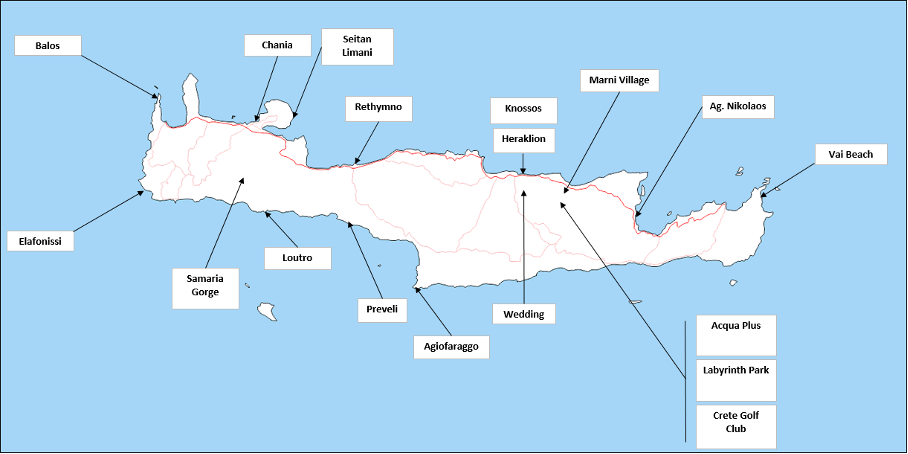
The island is separated into 4 prefectures: Heraklion, Chania, Rethymno, and Lassithi.
The mythical Crete island is one of the most popular Greek destinations, thanks to its unreal Crete beaches, its amazing historical sites, such as Knossos Palace and Spinalonga islet, and its mesmerizing natural landscapes.
Not to mention Chania town and Heraklion town some of the biggest towns in Crete, which boast magnificent medieval architecture. Honestly, wandering around their warren of romantic alleys will make you feel as if you’ve traveled back in time!
Crete is, hands down, one of the most magical Greek islands!
Chania
Chania is a city on the northwest coast of the Greek island of Crete. It’s known for its 14th-century Venetian harbor, narrow streets and waterfront restaurants. At the harbor entrance is a 16th-century lighthouse with Venetian, Egyptian and Ottoman influences.
Heraklion
Though not pretty in a conventional way, Iraklio definitely grows on you if you take the time to explore its layers and wander its backstreets. You'll discover a low-key urban sophistication with a thriving cafe and restaurant scene, good shopping and bustling nightlife. A revitalised waterfront invites strolling, and the newly pedestrianised historic centre is punctuated by bustling squares flanked by buildings from the time when Christopher Columbus first set sail.
Rethymno
Basking between the commanding bastions of its 15th-century fortress and the glittering azure waters of the Mediterranean, Rethymno is one of Crete’s most enchanting settlements. Its Venetian-Ottoman quarter is a lyrical maze of lanes draped in floral canopies and punctuated with graceful wood-balconied houses, ornate monuments and the occasional minaret. Crete's third-largest centre has lively nightlife thanks to its sizable student population, some excellent restaurants and a worthwhile sandy beach right in town. The busier beaches, with their requisite resorts, line up along a nearly uninterrupted stretch all the way to Panormo, some 22km away.
Agios Nikolaos
Lasithi’s capital, Agios Nikolaos has an enviable location on hilly terrain overlooking the sensuously curving Bay of Mirabello. There’s a strong local character to Agios Nikolaos that imbues it with charismatic, low-key flair. A narrow channel separates the small harbour from the circular Voulismeni Lake, whose shore is lined with cafes and restaurants.
Loutro
Loutro is a quaint fishing village on the south coast of Crete. The amphitheatrical bay, lying right by the sea, boasts a unique waterfront made of whitewashed buildings, blue windows, and pink blossomed bougainvillea. A unique reminder of the Cycladic landscape… but on Crete! Peaceful and quiet, Loutro can be accessed only by sea or on foot, making the area ideal for those who seek to destress, reconnect and reset. Loutro exudes an unmatched tranquility authenticity that permeates every corner of the tiny settlement.
🏛️ Art, History, and Architecture
Things to see & do in Crete are unlimited and ideal for all preferences. All regions of Crete offer something special to visitors all year round. Certainly, most tourists visit Greece in summer and stay on the northern coasts, but the island offers many off-season activities even in winter, such as hiking or sightseeing drives.
Palace of Knossos
Crete’s most famous historical attraction is the Palace of Knossos, the grand capital of Minoan Crete, located 5km south of the city of Ηrakleio. The setting is evocative and the ruins and recreations impressive, incorporating an immense palace, courtyards, private apartments, baths, lively frescoes and more.
Preveli Monastery
Historic Moni Preveli cuts an imposing silhouette high above the Libyan Sea. Like most Cretan monasteries, it was a centre of resistance during the Turkish occupation and also played a key role in WWII, hiding trapped Allied soldiers from the Nazis until they could escape to Egypt by submarine. A small museum features exquisite icons, richly embroidered vestments and two silver candelabra presented by grateful soldiers after the war.
🌊 Beaches
Crete is the largest island of Greece and its coastline of 1,046 m (650 miles) provides hundreds of beautiful beaches. Located between the southern side of the Aegean Sea and the northern side of the Libyan Sea, Crete gets very popular in summer due to the gorgeous beaches, the traditional lifestyle of the locals, and the beautiful nature. Crete is considered to have some of the most beautiful beaches in Greece and someone can swim almost everywhere.
The part of Crete with the best beaches is definitely Chania. One of the most exotic sandy beaches of Crete is Balos, a wonderful place in Chania with crystal Caribbean-like water. This place amazes visitors with stunning natural beauty. Another of the most beautiful beaches of Crete is the exotic Elafonissi in Chania, on the westernmost spot of Crete, as well as the long, sandy beach of Falassarna.
Balos
The rugged Gramvousa Peninsula cradles the lagoon-like sandy beach of Balos, whose shallow, shimmering turquoise waters draw huge crowds in summer. This remote stretch features on many tourist brochures for Crete, and when it's at its best it's a heavenly scene, with lapping waters shimmering with darting fish. If the tide is out, the wind is whipping up or it's overrun by visitors off the cruise ferry, it can be something of a letdown.
Elafonissi
Tucked into Crete’s southwestern corner, this symphony of fine pink-white sand, turquoise water and gentle rose dunes looks like a magical dreamscape. As the water swirls across the sands, rainbows shimmer across its surface.
Preveli Beach
Also known as Palm Beach, dazzling Preveli is one of Crete’s most celebrated strands. At the mouth of the Kourtaliotiko Gorge, where the river Megalopotamos empties into the Libyan Sea, the palm-lined riverbanks have freshwater pools good for a dip. The beach is backed by rugged cliffs and punctuated by a heart-shaped boulder at the water’s edge.
Seitan Limani
While it might be a white-knuckle drive down hairpin bends to get here, the incredibly vivid turquoise waters of this secret cove are more than worth it. Take in the views from the top or brave the steep, rocky path that leads down to the remote, tiny, sandy beach to take a dip. It's located on the northeastern side of the Akrotiri Peninsula.
Vai Beach
The beach at Vaï, is famous for its large grove of Phoenix theophrasti (Cretan date) palms. With calm, clear waters, it's one of the island's most popular strands and its tightly spaced rows of umbrellas and sunbeds often fill by 10am in July and August. Jet skis kick into gear shortly thereafter. Snack bars and a reasonably priced taverna provide refreshments.
Agio Farago
Agio Farago is a clean pebble beach with crystal clear turquoise blue water. West of the beach is a beautiful rock arch where you can swim through. Vertical cliffs surround the beach
🌿Hikes
Crete has more than 250 small or long gorges, more than any other region of Crete. Many of these gorges are inaccessible and dangerous to cross, while others are more accessible and various activities have developed there over the last years, such as hiking, rock climbing or even bungee-jumping. In fact, the only bungee jumping spot in Crete and the highest in the Balkans is the bridge over Aradena Gorge in southern Chania.
The regions of Sfakia and the White Mountains in Chania have impressive gorges. In the prefecture of Rethymno, gorges are smaller and easier to access, such as Myli and Kourtaliotikos Gorge. Heraklion has many gorges running Psiloritis Mountain, while Lassithi has the most dangerous gorges in Crete, including Ha Gorge and the Gorge of the Dead.
Samaria Gorge:
Hiking the 16km-long Samaria Gorge, one of Europe's longest canyons, is high on the list of must-dos for many visitors to Crete. There’s an undeniable raw beauty to the canyon, with its soaring cliffs and needlenose passageways. The hike begins at an elevation of 1230m just south of Omalos at Xyloskalo and ends in the coastal village of Agia Roumeli. It's also possible to do it the 'lazy way': hiking a shorter distance by starting at Agia Roumeli. The only way out of Agia Roumeli is by taking the boat to Sougia or Hora Sfakion, which are served by bus and taxi back to Chania.


